
If day one of the Mobile Network Innovation Summit focused on challenging the prevailing belief that telcos are ‘bad’ at innovation, then day two brought a more practical lens to the discussion around what it actually takes to scale innovation in an industry shaped by long investment cycles, complex procurement structures, and infrastructure dependency.
The second and final day of the inaugural event moved beyond the headline question of whether the industry can innovate, and instead explored how innovation becomes commercially viable. Across investor panels, operator-led scale-up sessions, and deep dives into AI-native networks and quantum communications, the overarching theme was clear – the gap between innovation and deployment is rarely about technology alone.
Instead, it is defined by funding pathways, execution capability, and the realities of operating within a highly interconnected ecosystem.
The investment lens
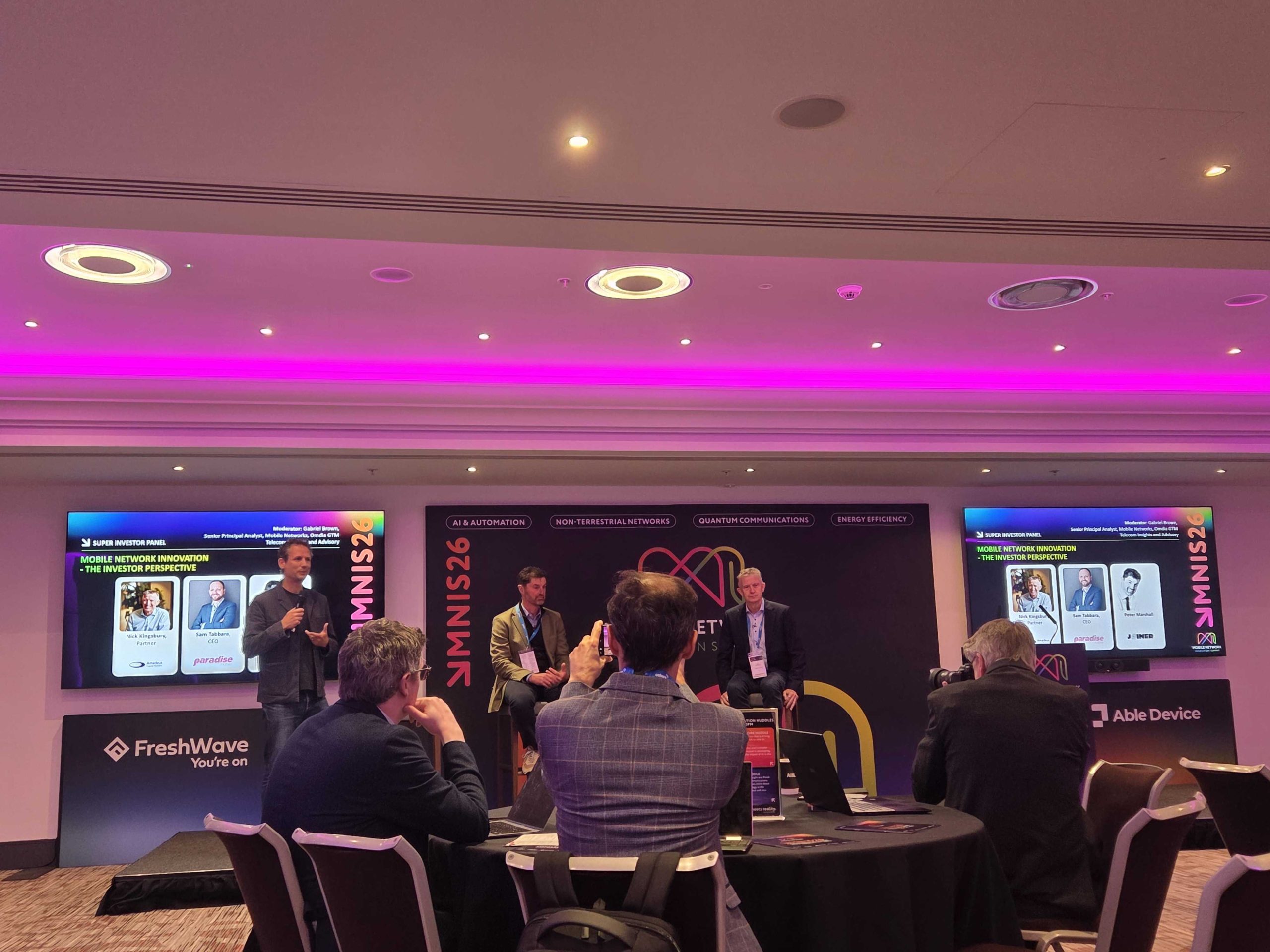
The day opened with a super investor panel, exploring mobile network innovation from the perspective of capital allocation and commercial return.
All the panellists broadly agreed that while innovation across the telco sector is active, it remains highly fragmented. As a result, value creation often depends on long development and deployment cycles, deep infrastructure expertise, and the ability to navigate operator-led procurement environments.
Scaling up – and the reality check that comes with it
A keynote session from Tomorrow Street, Vodafone’s innovation centre focused on scaling late-stage startups, brought the discussion into sharper focus, particularly around what it means to take emerging technologies from pilot to deployment inside telco environments.
This was followed by one of the day’s standout sessions, ‘Learning from those with the scars’, where CEOs from TEOM.ai, RANsemi and Cohere Technologies shared candid insights and anecdotes from their entrepreneurial journeys.
While some of the early disasters ranged from comical incidents such as leaving a prototype on a train, other learnings centred on the more serious realities of the startup journey, from the fear of “running out of money” to “actually running out of money”.
Despite their varied experiences, their core lessons were consistent: the importance of timing within fundraising cycles, the risks of making bold claims too early, the operational strain of scaling teams, and the value of having investors and board members who truly understand the telecoms landscape.
AI-native networks – from concept to commercial reality
AI and automation, and more specifically the evolution towards AI-native networks, were the dominant themes in the second half of the day.
A keynote from Vodafone Three explored both progress to date and the challenges ahead, framing the move towards an “automated, AI-native network” as a major inflection point for the industry rather than an incremental shift.
This was followed by a series of innovator showcases. Across the presentations, there was a clear focus on practical applications, from AI-driven network optimisation tools, to technologies tackling signal processing challenges in highly dense device environments.
The final innovation panel of the day explored where AI-driven innovation is creating genuine value in network operations. Moderator Simon Saunders posed a hypothetical question to the panel: if given $100 million to invest in network innovation, where would they allocate it?
The responses highlighted a familiar tension between near-term commercial deployment and longer-term foundational research. Answers ranged from investing in startups building applied AI solutions to continued investment in academic research.
Closing reflections
Across the day, the focus remained consistent – less about isolated technological breakthroughs, and more about the systems required to make innovation deployable at scale.
In that sense, the discussion ultimately centred on how the industry bridges the gap between strong innovation pipelines and the structural realities that determine how quickly, and effectively, those ideas reach commercial deployment.
